
25 Memorial Photo & Picture Ideas for Service and Home
The memorial photo ideas families use most are a photo board or slideshow for the service, one well-printed portrait, a memorial collage or photo mosaic for the home, and small keepsakes such as photo books and lockets for the family. If the service is this week, start with a remembrance wall (#1), a slideshow (#2) and a memory box (#4): they need nothing but prints and a box.
Below are 25 memorial picture ideas, grouped by when you'll need them: for the service, for the home, as keepsakes for the family, for the years after, and four printed pieces that carry a name, a date or a place. After those come ideas for a memorial photoshoot and for the first Christmas without them. Skip to whichever is closest. After a loss, photos change jobs — they stop being clutter on a phone and become the most valuable thing you own.
For the service or celebration of life
1. A remembrance wall guests can walk along
A large board, a clothes-line with pegs, or simply prints taped to a wall — loose, unframed, unstructured on purpose. People stop, point, and add stories to the photos as they pass. Print 40–80 photos at 10×15 cm; a corner shop or supermarket kiosk does it in an hour. Afterwards the prints go into a memory box (see #4) rather than the bin.
2. A slideshow set to their music
The most-used memorial photo idea for a reason. Practical numbers: 60–90 photos at 4–5 seconds each fills three songs. Put the photos in rough life order, mix portraits with candid ones, and end on the picture that is most them. Export it as a video file and bring it on a USB stick and your phone — venue laptops fail.
3. A photo table with their things
One or two framed portraits beside objects — reading glasses, a recipe card in their handwriting, a fishing lure, a well-worn book. Photos alone are flat; a photo next to the thing they held is a person.
4. A memory box, filled by everyone
A plain wooden box on a table, a stack of cards, one line of instruction: write one memory. Keep the cards with the photos afterwards. On anniversaries the box gets opened. This is the lowest-effort idea on this list and routinely the most treasured years later.
5. A photo on the order of service
A single warm portrait on the front of the programme, and a few candid photos inside. Guests keep these. Choose a photo where they're looking at the camera and smiling naturally — the school-portrait style rarely reads as them.
6. A memorial photo mosaic as the centrepiece
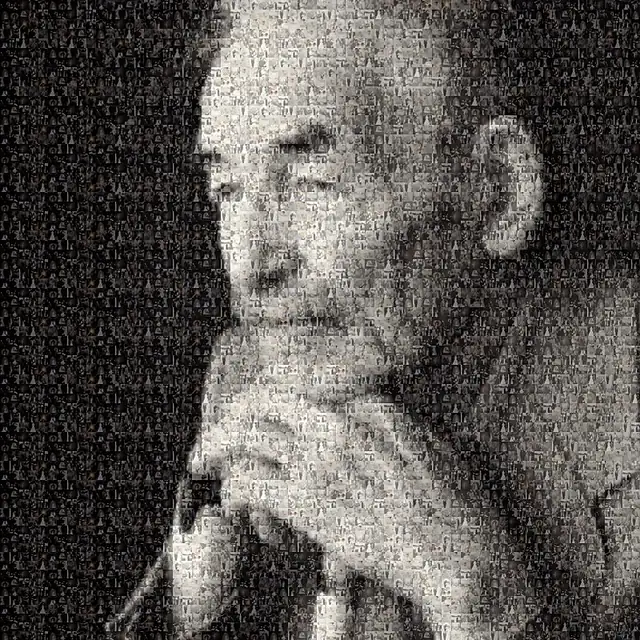
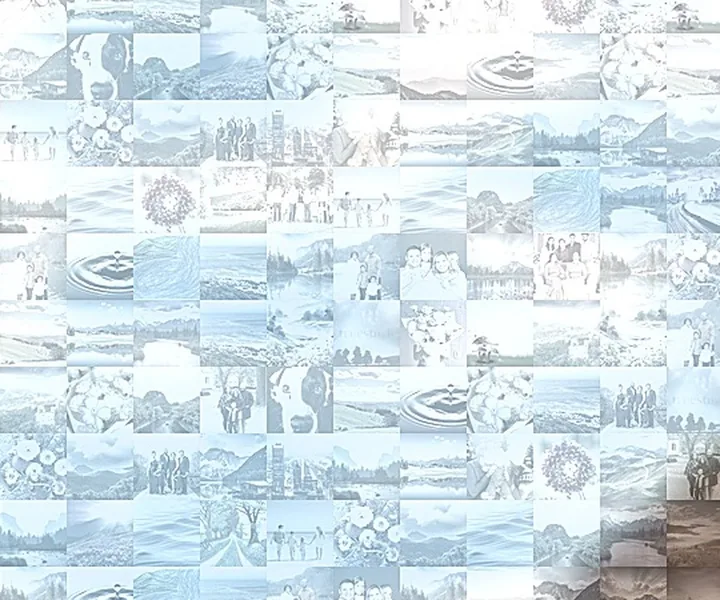
Where a family wants a single piece to gather around, a photo mosaic does something no other format can: one portrait of the person, built out of hundreds of smaller photos of their life. From across the room it's their face. Up close, it's every holiday, wedding, ordinary Tuesday and family gathering they were part of.
It works best as a family project: everyone sends their own photos of the person, so the finished piece holds each relative's private memories. At the service, guests find the moments they were in. Afterwards it goes home with the family. You can make a memorial photo mosaic at getmoza without an account: upload the photos, see a free preview, and take your time deciding. It can stay a digital keepsake (from €9.95) that every household prints for itself, or become a framed print. One honest note: choose a main photo with good light and a clear face; the mosaic can only be as strong as the portrait it builds from. More on this in what makes a true photo mosaic.
When relatives live far apart. You don't have to chase everyone for photos one by one. Start a photo collection and you get one link, plus a QR code you can print for the service. Anyone can add photos from their phone without an account, you approve what comes in, and then you build the memorial mosaic from all of it. If more photos arrive after the funeral, you can approve them and build it again.
For the home
7. One portrait, printed properly
Not a collage, not a wall — one photo, chosen with care and printed on something that lasts (fine-art paper behind glass, aluminium, or a canvas). It sounds obvious; most families never do it, and the best photo of a person stays at 1,200 pixels on someone's phone. Ask the family which single photo is them, then print it larger than feels comfortable. A 30×40 cm print holds a room.
8. A gallery wall of the decades
Six to twelve frames, one or two photos per decade of their life, hung in loose chronological order. It tells the whole story in a glance and lets younger relatives meet the twenty-year-old version of a grandparent. Mixed frames feel warmer than a matched set.
9. A "then and now" pairing
Two photos side by side: the same place, the same pose, or the same two people, decades apart. Wedding day and fiftieth anniversary. First house and last visit to it. This is the format that makes people cry, in the good way.
10. A shadow box with a photo and an object
A deep frame holding a photo and something physical: the watch, a medal, a folded letter, the concert ticket. Museums use shadow boxes for a reason — objects carry presence.
11. The ordinary-moments album
Resist the urge to use only the "good" photos. An album that includes the blurry kitchen shots, the mid-laugh photos, the terrible angles — that's the person as they actually were. Give it a plain title, the kind of thing they would have said, rather than "In Loving Memory".
12. A photo mosaic in the hallway
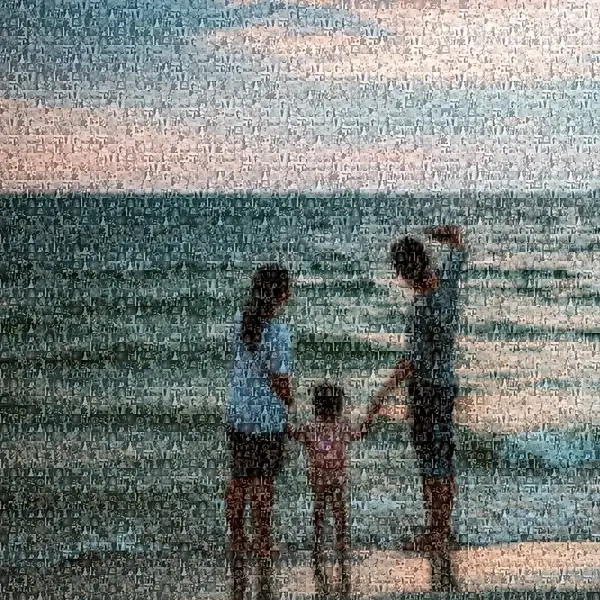
The same idea as #6, but chosen for daily life rather than the service: a classic photo mosaic where the tiles are the family's own photos, hung where people pass it every day. Visitors stop and look for themselves in it. Prints at getmoza start at €39 (fine-art paper), canvas at €79 and framed at €315; the digital file is €9.95 if you'd rather print locally.
The main photo doesn't have to be a close-up portrait. A favourite moment works too: the walk on the beach, the garden, the last holiday together. The face matters less when the place was theirs.
Keepsakes for the family
13. Photo books, one per branch of the family
A shared album often ends up in one house. Instead, build one photo book and order a copy for each sibling or grandchild. Ask each branch to contribute ten photos and one page of text. It's the memorial idea most likely to still be looked at in twenty years.
14. A small photo something they can carry
A locket, a keyring, a wallet-size print laminated at the copy shop. Small, private, and — for the person who was closest — sometimes more comforting than anything on a wall.
15. A photo blanket or cushion
Especially for grandchildren and for anyone in care. Slightly kitsch, entirely beloved. Use one clear photo or a simple grid, not a busy collage.
16. A recipe card, framed with a photo of them cooking it
If they cooked, this is the one. Their handwriting on the card, next to a photo of them in the kitchen. Copies for everyone who will make the dish.
17. A digital copy of the mosaic for everyone
If the family made a mosaic (#6), the digital file is the easiest keepsake to share: every relative gets the same image, in full resolution, to print at whatever size fits their home. It also lets you decide about a framed print later, when you're ready.
For the years after
18. A shared family album that stays open
Create a shared album (Google Photos, iCloud, or similar), invite the whole family, and leave it open. Photos surface for years — a cousin finds a shoebox, a friend sends a picture from 1988. It also quietly becomes the source library for anything on this list you decide to make later.
19. A rotating digital frame
For a grandparent or anyone living alone: a digital frame loaded with a few hundred photos, changing every minute. Family members can usually add photos remotely, so it keeps growing.
20. A short video from the clips you already have
Most phones hold ten seconds of someone laughing, singing at a birthday, waving from a car. Stitch five or six of those together. Voice and movement carry something a photo can't. Keep it under two minutes; it will be watched more, not less.
21. A yearly photo ritual
Grief has anniversaries. Some families print one photo each year on the person's birthday and add it to a wall or album — the memorial grows instead of fading. It helps children in particular, who get to keep participating rather than being handed a finished thing.
Four printed pieces with a name, a date or a place
22. A memorial photo collage, designed rather than crammed
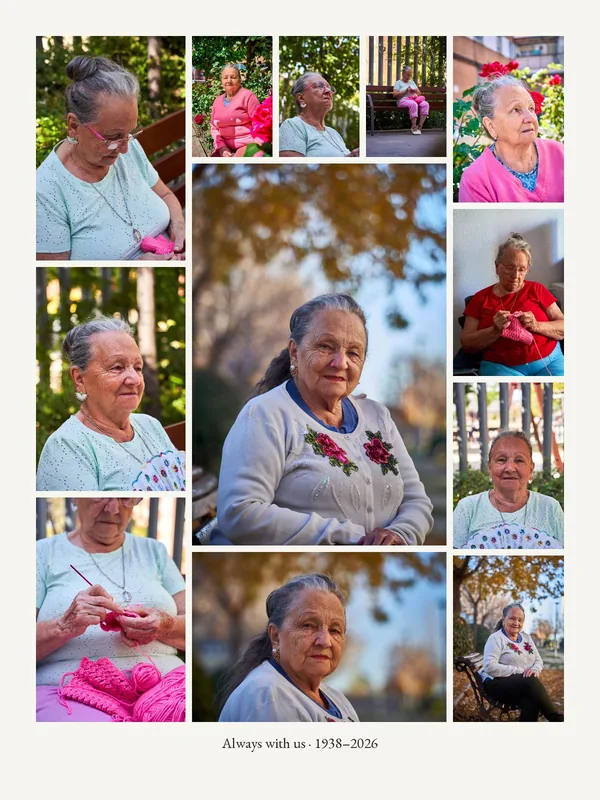
Where a mosaic hides hundreds of photos in one portrait, a collage shows a few dozen at a size you can actually look at. The trap is the home-made grid where faces get cropped and tiny photos blur. A memorial photo collage laid out by a tool that never cuts a face works better: getmoza's In memory collage takes 4–40 photos, puts one chosen photo at the centre, adds one optional line of text (a name and the years) and prints on fine-art paper.
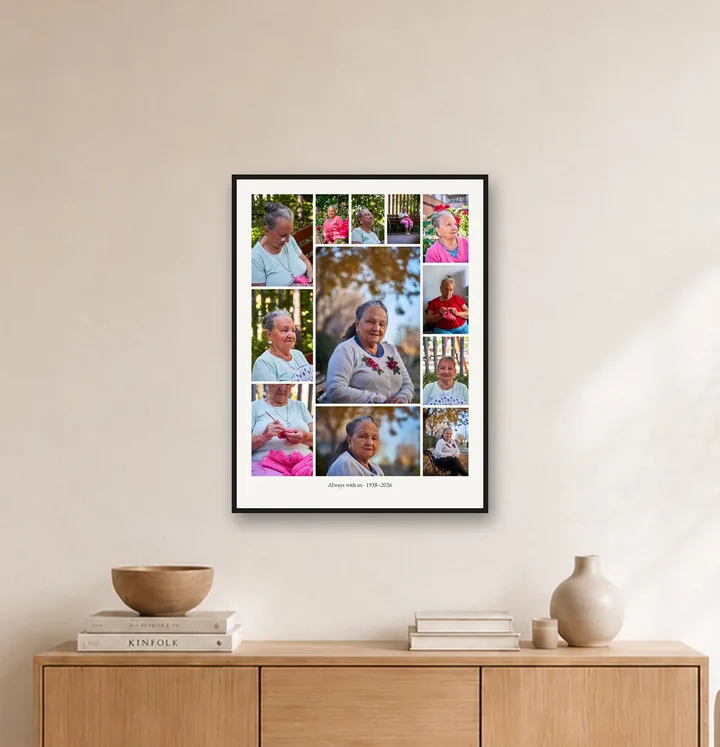
23. An "in loving memory" portrait with name and dates
One portrait with their full name and years underneath, printed at 30×40 cm or larger and placed at the entrance of the service. Afterwards it becomes the portrait in the family home. Keep the type small and plain; the face does the work.
24. A photo plaque for a bench, tree or grave
Ceramic and metal photo plaques are made for outdoors and sit on a memorial bench, beside a planted tree or on a headstone (check the cemetery's rules first). Use a clear, well-lit face photo: the plaque is small, so detail matters more than composition.
25. A QR code to a shared memorial album
Print a small QR code on the order of service or beside the photo table that opens a shared online album (#18), or a getmoza collection if you're planning a mosaic. Guests add their own photos from their phones during or after the service, and you end up with pictures nobody in the family had seen.
Memorial photoshoot ideas
A memorial photoshoot is a session the family plans in someone's honour: sometimes with a photographer, often just with a good phone and a quiet afternoon. It isn't for everyone, and there's no right time for it. These are the ideas that tend to mean the most:
- At their place. The bench they always sat on, the allotment, the lake, the pub table by the window. Photograph the family there, or just the place itself in the light they liked.
- Holding their photo. A family portrait where the youngest grandchild holds a framed photo of them. It brings them into a picture they can no longer be in.
- With their things. His hat, her scarf, the guitar, the gardening gloves, worn or held by the people who loved them. A wedding ring on a grandchild's hand. Close-ups work better than wide shots.
- Recreate an old photo. Find a photo of them in a place you can still go to, stand in the same spot and take it again with whoever is left. Print the two side by side (see #9).
- The home, before it changes. If the house will be cleared or sold, photograph it room by room as it is now: the kitchen counter, their chair, the view from the window, the handwriting on the calendar. It takes an hour, and it can't be done later.
- Everyone they leave behind, in one frame. Children, grandchildren, partners, the dog. It's a hard photo to organise and a precious one to have, and it makes a strong main photo for a mosaic of all their other pictures.
- For a pet. Their favourite walk, the collar on the bed, the empty bowl, the paw print in clay. Keep it small and private if that suits you better.
A few practical things: use daylight and no flash, let people be sad in the photos, and let children take some of the pictures themselves. If you'd like photos of the service itself, ask the immediate family first, then give one trusted friend the job, so nobody else needs to hold up a phone.
The first Christmas without them
The first Christmas after a death is often the hardest day of the year, and nobody gets it right. Some families keep every tradition the same. Others change all of them. Both are fine. Photos can help, quietly, if you want them to:
- A place for them at the table. Some families leave a chair with their photo on it. Others set a small framed photo and a candle in the middle of the table and light it before the meal. If that feels like too much, a photo on the sideboard is enough.
- One photo on the tree. A small print in a clear glass ornament, or a photo ornament with their name. Children can choose which photo goes on it.
- One story each. Ask everyone to bring one photo and one short memory to Christmas dinner, then add them to the memory box (#4). It gives people a way to talk about them without anyone having to start the conversation.
- Look through the photos together. Put the shared album (#18) or the slideshow from the service (#2) on the TV in the afternoon. People drift in and out.
- A gift for someone who is grieving. A framed photo of the person, a photo book, or a printed portrait from family photos. Keep it about them, not about the loss, and give it privately rather than in front of everyone. A card that says I was thinking about him often matters as much as the gift.
If you'd like to give a memorial photo mosaic or an In memory collage at Christmas, prints ordered by 5 December should arrive before Christmas. A digital file can be printed locally at any time. But a memorial piece doesn't have to be ready by any date: if the family isn't ready yet, January or the first anniversary is just as good a time.
Choosing between them: display, portrait or keepsake
There's no wrong answer, but a rule of thumb: boxes and albums are private grief; walls and mosaics are shared presence. If the person was the centre of a big family, something visible — a wall, a mosaic in the hallway — tends to comfort more people than something stored away. If you're preparing for a service this week, do #1, #2 and #4 — they need nothing but prints and a box. The framed pieces can wait until you can breathe.
How to choose the photos
- Ask everyone. Send one message to the family and friends: "Send me your photos of X — all of them, don't sort." You'll get pictures you've never seen. A shared album (#18) makes this painless.
- Scan the prints. Old printed photos are usually the best ones. A phone scanning app in daylight is fine; ask a copy shop if there are hundreds.
- Portrait first, everything else second. For a single print or a mosaic, the one main photo matters most: face clearly lit, eyes visible, taken from roughly eye level. Everything else can be imperfect.
- Include the ordinary. The kitchen, the garden, the dog, the car. Formal photos show what someone looked like; ordinary photos show who they were.
If a mosaic feels right, try the preview whenever you're ready. It's free, there's no account, and nothing is ordered until you decide. Related: what to do with old photos and meaningful anniversary gift ideas.
Frequently asked questions
What are good memorial photo ideas?
For the service: a remembrance photo wall or board, a slideshow set to their music, a photo table with their belongings and a memory box for written memories. For the home: one portrait printed properly, a gallery wall of the decades, a memorial photo collage or a photo mosaic. For the family: photo books for each household, lockets and digital copies everyone can print.
How many photos do you need for a memorial photo mosaic?
There's no hard minimum. The preview asks for 30 photos, 100+ different photos give the richest result because fewer of them repeat, and you can add up to 300. Photos can be any mix of portraits, group shots and everyday moments: the mosaic uses each one wherever its colours fit.
Which photo works best as the main image?
A clear, well-lit photo of their face, taken from about eye level, where they look like themselves — usually a natural smile rather than a formal portrait. Avoid heavy shadows, sunglasses and very busy backgrounds; the mosaic can only be as strong as the portrait it is built from.
Can family members in different places contribute photos?
Yes. One way is a shared online album everyone can add to, then upload the collected photos in one go. The other is a getmoza collection: you share one link or QR code, relatives upload from their own phones without an account, you approve the photos, and the mosaic is built from everything that came in.
Is a photo memorial gift appropriate to give to someone grieving?
Generally yes, because it is about the person rather than the loss. Something small and quiet — a framed photo, a photo book, a digital mosaic they can print later — is safer than a large piece they have to find wall space for.
What should I do with old printed photos after the service?
Scan them before anything else, so every family member has a copy, then keep the originals together in one box with the memory cards from the service. Once they're digitised, they can go into a photo book, a shared album or a mosaic without any risk to the originals.
What can we do with photos at the first Christmas without them?
Keep it small and let the family decide. Common ideas are a framed photo and a candle on the table, one photo ornament on the tree, everyone bringing one photo and one memory to dinner, and looking through the shared album together in the afternoon. It's fine to skip all of it in the first year.
What is a memorial photoshoot?
A photo session planned in someone's memory: the family at their favourite place, holding their photo or their belongings, recreating an old picture, or photographing their home before it is cleared. It can be done with a photographer or with a phone, in daylight and without flash.
Turn your photos into one piece of art
Upload your photos and see a free mosaic preview in seconds — no signup.
Create your mosaic free